Lightweight Deflectometer (LWD) Test: Fast Compaction QC & Evd
The traditional way to prove a compacted layer is strong enough — the plate load test or a soaked lab CBR — takes hours to days and stops work while everyone waits. The Lightweight Deflectometer (LWD) gives you the same answer in about two minutes, standing on the layer itself. That’s why it’s quietly become […]
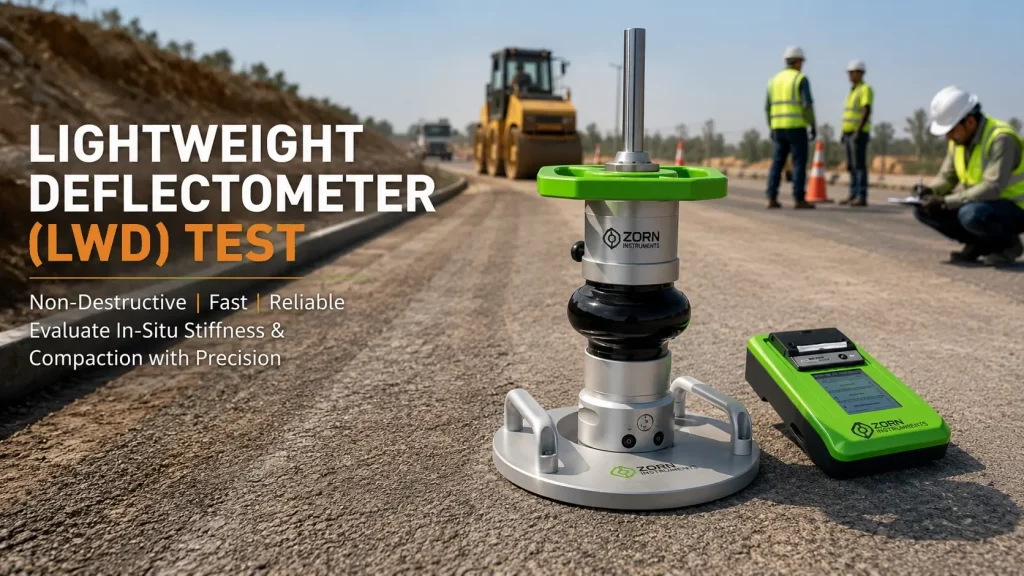
The traditional way to prove a compacted layer is strong enough — the plate load test or a soaked lab CBR — takes hours to days and stops work while everyone waits. The Lightweight Deflectometer (LWD) gives you the same answer in about two minutes, standing on the layer itself. That’s why it’s quietly become the on-site compaction check of choice for highway, railway and earthwork QC.
An LWD drops a known weight onto a bearing plate and measures how far the ground deflects under the impact. From that deflection it computes a dynamic deformation modulus, Evd (MN/m²) — a direct, repeatable number for the stiffness of the layer you just compacted, correlating to CBR and plate-load results.
Why site teams switched to the LWD
- Fast: one test in ~2 minutes vs hours for a plate load test — you check density as you build, not after.
- Portable: one person carries and runs it; no reaction truck or loaded vehicle needed.
- Repeatable: a clean Evd number that’s easy to specify, log and audit.
What the LWD measures
The impact simulates a moving-wheel load. A sensor (geophone or accelerometer) records the plate’s peak deflection, and the device calculates Evd from the load, plate radius and deflection. Higher Evd = stiffer, better-compacted layer. It’s governed internationally by ASTM E2835 and the German TP BF-StB Part B 8.3 method that popularised the Evd approach.
Test procedure
- Level a small area and seat the bearing plate firmly on the compacted layer (a thin sand bed helps full contact).
- Apply two or three seating drops to bed the plate.
- Apply the measurement drops; the device records deflection and computes Evd automatically.
- Compare Evd against the project specification for that layer.
Typical Evd acceptance (indicative)
| Layer | Typical Evd target (MN/m²) |
|---|---|
| Subgrade / formation | ≈ 25–45 |
| Sub-base (granular) | ≈ 45–60 |
| Base / capping | ≈ 60+ |
Always use the value in your project/contract specification — targets vary by layer, material and authority. Treat the above as indicative ranges, not acceptance limits.
Where it’s used
Highway and expressway earthworks, railway formation and ballast, airport runways, backfill behind retaining walls and around utility trenches, and pad/foundation subgrades — anywhere you need fast, documented proof of compaction stiffness.
Choosing a Lightweight Deflectometer in India
JS Civil Lab Solutions supplies portable Lightweight Deflectometers with integrated data logging and Evd output, calibration-certified, for NHAI/PWD contractors, railways and QC labs, with pan-India delivery and training. Call or WhatsApp +91 93596 24761, or view it here:
→ Lightweight Deflectometer (LWD)
Related: Soil & subgrade testing equipment
Frequently asked questions
What does a Lightweight Deflectometer measure? It measures the dynamic deformation modulus Evd (MN/m²) — the in-situ stiffness of a compacted layer — from the deflection under a falling-weight impact.
Is the LWD better than a plate load test? It’s far faster (minutes vs hours) and portable, so it’s used for rapid, repeated on-site QC. The static plate load test is still used where the contract specifically requires it.
How does Evd relate to CBR? Higher Evd broadly corresponds to higher CBR and better compaction, and correlations exist, but they depend on the material — always verify against the project specification.