California Bearing Ratio (CBR) Test: Procedure & Value Interpretation (IS 2720)
Every road you’ve ever driven on rests on a number most drivers have never heard of: the CBR value. Get it wrong at the subgrade and the pavement above it cracks, ruts and fails years early — no matter how good the bitumen on top is. The California Bearing Ratio (CBR) test is how engineers […]
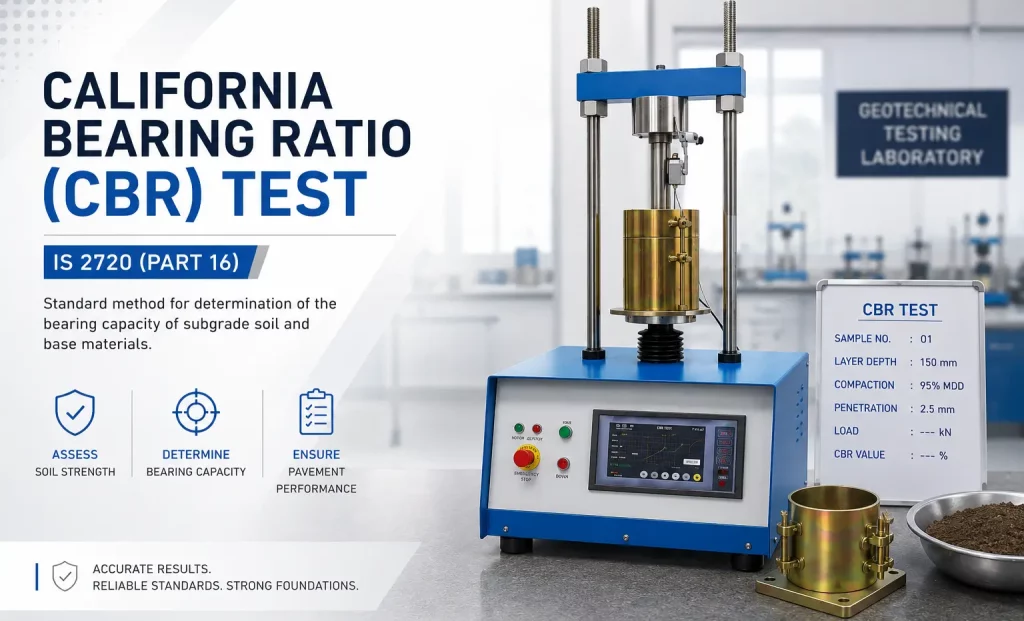
Every road you’ve ever driven on rests on a number most drivers have never heard of: the CBR value. Get it wrong at the subgrade and the pavement above it cracks, ruts and fails years early — no matter how good the bitumen on top is. The California Bearing Ratio (CBR) test is how engineers put a strength number on the soil before a single layer goes down.
CBR compares the load your soil can take against the load a standard crushed-stone material takes, as a percentage. A CBR of 2% is soft clay you’d never build on directly; 80%+ is a well-graded granular base. In India the test follows IS 2720 (Part 16) for the lab method and IS 2720 (Part 31) for the in-situ field method, and the result feeds straight into pavement thickness design under IRC:37.
Lab CBR vs field CBR — they’re different tools
- Laboratory CBR (IS 2720 Part 16): a remoulded, compacted soil sample is soaked and penetrated in a load frame. Used at the design stage to characterise a soil.
- Field / in-situ CBR (IS 2720 Part 31): the penetration is done on the actual compacted subgrade on site. Used for quality control — proving the road you just built matches the design.
Equipment required
- CBR test apparatus — mould (150 mm dia), a load frame with proving ring (or load cell), and a 50 mm penetration plunger
- Surcharge weights (annular and slotted) to simulate the pavement load above
- Dial gauges for penetration, a soaking tank, and compaction rammers
Test procedure (IS 2720 Part 16)
- Compact the soil into the mould at the required density and moisture.
- Soak it for 96 hours (4 days) under surcharge weights, recording swell — this simulates the worst-case saturated subgrade.
- Mount the mould in the load frame and drive the plunger at 1.25 mm/min.
- Record load at 2.5 mm and 5.0 mm penetration.
- CBR (%) = (test load ÷ standard load) × 100, taken at 2.5 mm (and checked at 5.0 mm).
What CBR values mean
| CBR value | Soil rating | Use |
|---|---|---|
| 0–3% | Very poor | Soft subgrade — needs treatment/replacement |
| 3–7% | Poor–fair | Subgrade |
| 7–20% | Fair–good | Sub-base |
| 20–50%+ | Good–excellent | Base course, granular fill |
Common mistakes
- Skipping the 4-day soak to save time — unsoaked CBR overstates strength and under-designs the pavement.
- Wrong penetration rate — it must be 1.25 mm/min; faster gives a falsely high value.
- Uncalibrated proving ring — mandatory for NABL, NHAI and PWD submissions.
Choosing a CBR apparatus in India
JS Civil Lab Solutions supplies both laboratory and field CBR sets per IS 2720 (Parts 16 & 31) — mould, load frame, plunger, surcharge weights and dial gauges — with traceable calibration and pan-India delivery for NABL labs, NHAI/PWD contractors and colleges. Call or WhatsApp +91 93596 24761, or view them here:
→ Field CBR Test Apparatus (in-situ, IS 2720 Part 31) · Laboratory CBR Machine (IS 2720 Part 16)
Frequently asked questions
What is a good CBR value for road subgrade? A CBR of 8% or more is generally desirable for subgrade; below about 5% the soil usually needs stabilisation or replacement. Base courses need 20% and above.
What is the difference between soaked and unsoaked CBR? Soaked CBR (4-day soak) simulates the worst-case saturated subgrade and is used for design; unsoaked CBR is higher and only valid where the soil will never saturate.
Which IS code covers the CBR test? IS 2720 Part 16 for the laboratory method and IS 2720 Part 31 for the in-situ field method; pavement design uses the result under IRC:37.