
Air Entrainment Meter — How to Test Air Content of Fresh Concrete (IS 1199)
Step-by-step guide to measuring air content in fresh concrete with a pressure-type air entrainment meter: IS 1199 / ASTM C231 procedure, typical air content limits, aggregate correction and calibration practice.
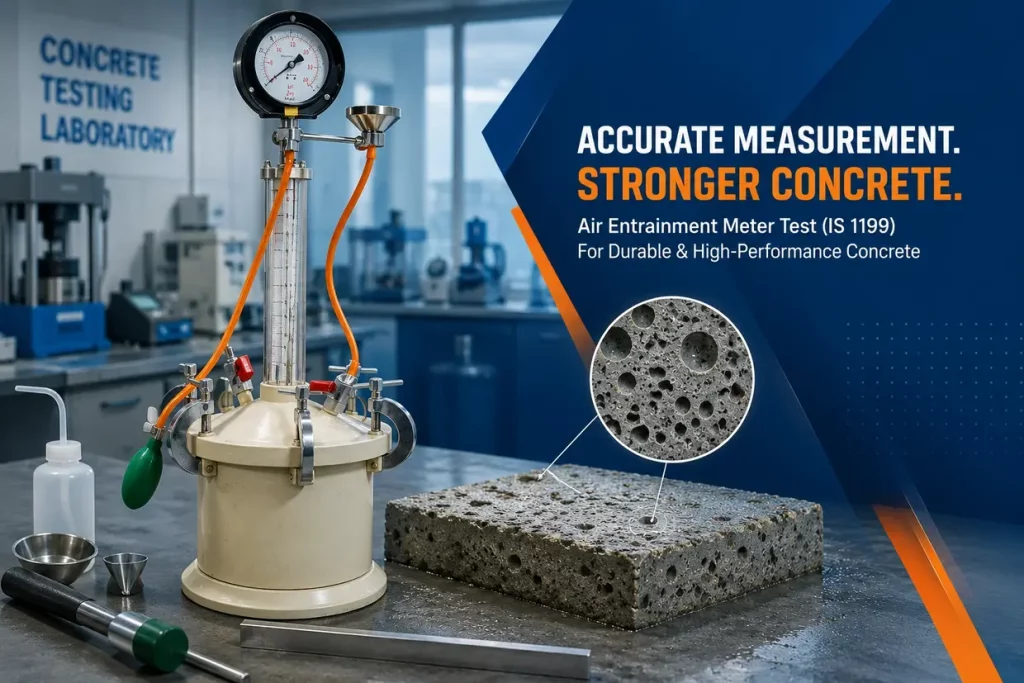
Air content is a critical property of fresh concrete: entrained air improves workability and freeze–thaw durability, but every 1% of excess air can cut compressive strength by roughly 5%. The air entrainment meter (pressure-type air content meter) is the standard site and laboratory instrument for measuring it, per IS 1199 and ASTM C231. This guide covers how the pressure method works, the equipment needed, the test procedure and typical acceptance limits.
Why Air Content is Measured
Concrete always contains some entrapped air from mixing. Air-entraining admixtures deliberately add microscopic bubbles that act as expansion chambers when water in the pores freezes — essential for pavements and structures in freeze–thaw climates, and useful for improving pumpability. But air must stay within specification: too little sacrifices durability, too much sacrifices strength. Ready-mix producers, site labs and precast plants therefore check air content on fresh concrete at the point of placement.
How the Pressure Method Works
The pressure-type air entrainment meter applies Boyle’s law: air is compressible, while water and aggregate are effectively not. A sealed vessel containing a compacted concrete sample is pressurised from a calibrated air chamber; the pressure drop observed when the two chambers equalise is proportional to the volume of air in the sample. The gauge is calibrated to read air content directly as a percentage.
Equipment Required
- Air entrainment meter — typically 5 or 7 litre capacity vessel with clamp-sealed lid, pressure gauge, air pump and calibrated air chamber
- Tamping rod — 16 mm diameter, 600 mm long, rounded end (as used for cube moulding)
- Strike-off bar and mallet
- Water supply for the water-injection variant
Test Procedure (IS 1199 / ASTM C231)
- Fill the bowl in three equal layers, rodding each layer 25 times and tapping the sides with the mallet to close rod holes.
- Strike off the surface flush with the rim and clean the flange.
- Clamp the cover on and inject water through the petcocks (water-type meters) until all air between the concrete surface and the lid is displaced.
- Pump the air chamber to the calibrated initial pressure line and allow it to stabilise.
- Release the valve connecting the chamber to the bowl and read the air content percentage directly from the gauge after light tapping.
- Apply the aggregate correction factor — porous aggregates absorb some pressure; determine the correction on aggregate alone and subtract it from the reading.
Typical Air Content Limits
| Concrete Application | Typical Target Air Content |
|---|---|
| Normal structural concrete (non air-entrained) | 1–2% (entrapped only) |
| Air-entrained concrete, 20 mm aggregate | 4–6% |
| Air-entrained concrete, 10 mm aggregate | 5–7% |
| Pumped concrete / CRCP pavements | Per mix design, commonly 3–5% |
Always verify the project specification — IRC and MoRTH pavement specs state their own limits, and exceeding the upper bound is as much a non-conformance as falling below the lower one.
Good Practice and Common Errors
- Calibrate monthly against the built-in calibration vessel, and after any gauge shock or transport
- Test within 5 minutes of sampling — air content changes as concrete sits, especially in hot weather
- Do not test after adding water on site — retempering changes the air-void system
- Pair with cube casting — record air content alongside cube specimens stored in a calibrated curing tank, so strength results can be interpreted against air data
Buying an Air Entrainment Meter in India
JS Civil Lab Solutions supplies pressure-type air entrainment meters conforming to IS 1199 and ASTM C231, alongside the complete range of construction and civil site testing equipment — slump cones, cube moulds, curing tanks and site lab kits — with calibration documentation and pan-India delivery. Not sure which capacity or type fits your site lab? Contact our technical team for a free specification consultation; we respond within one business day.
Frequently Asked Questions
What is the difference between entrapped and entrained air?
Entrapped air consists of large, irregular voids left by incomplete compaction — always undesirable. Entrained air consists of microscopic, deliberately introduced spherical bubbles (typically 10–300 µm) that improve freeze–thaw durability and workability.
Can the pressure method be used for lightweight aggregate concrete?
No. Porous lightweight aggregates absorb pressure and invalidate the reading — use the volumetric method (roll-a-meter) per ASTM C173 instead.
How accurate is a pressure-type air meter?
A calibrated instrument reads within ±0.1–0.2% air. Accuracy depends on monthly calibration checks and correct aggregate correction factors.