
Blaine Air Permeability Test — Apparatus, Procedure & IS 4031 Part 2 Values
How the Blaine air permeability test measures cement fineness: apparatus components, IS 4031 Part 2 / ASTM C204 procedure, acceptance values for OPC, PPC and GGBS, and the errors that most often invalidate results.
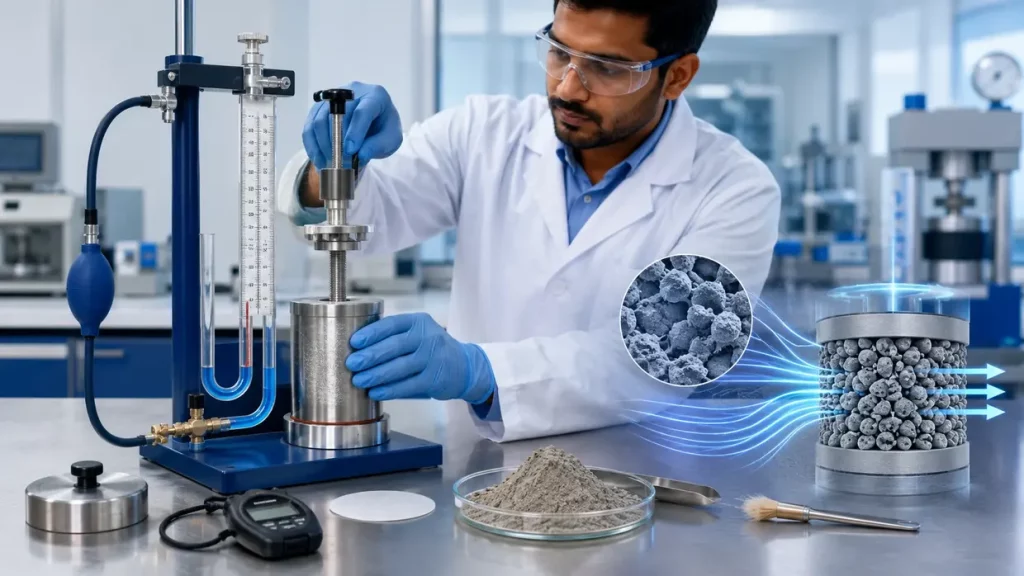
The Blaine air permeability test is the standard laboratory method for measuring the fineness of cement — expressed as specific surface area in m²/kg — as prescribed by IS 4031 Part 2, ASTM C204 and BS EN 196-6. Because fineness controls how quickly cement hydrates, it directly affects early strength gain, setting time, heat of hydration and water demand. This guide explains how the test works, the apparatus required, the step-by-step procedure and the acceptance values for common Indian cements.
What the Blaine Test Measures
Finer cement particles expose more surface area to water, so they hydrate faster. The Blaine method measures fineness indirectly: air is drawn through a compacted bed of cement of known porosity, and the time taken for a fixed volume of air to pass is recorded. Finer powder packs into a bed with narrower channels, resisting airflow for longer. The specific surface is then calculated by comparing the measured time against a standard reference cement of known fineness.
Blaine Air Permeability Apparatus — What You Need
A complete Blaine air permeability apparatus consists of:
- Permeability cell — a stainless steel cylinder (12.7 mm internal diameter) that holds the compacted cement bed on a perforated disc with filter paper
- Plunger — a calibrated push-fit piston that compacts the sample to the standard bed porosity of 0.500
- U-tube manometer — glass manometer with etched timing marks, filled with a non-volatile, non-hygroscopic light mineral oil
- Rubber aspirator bulb or vacuum pump — to displace the manometer liquid before timing
- Standard reference cement (SRC) — NIST or NCB reference material of certified specific surface, used to calibrate the instrument
- Stopwatch or integrated digital timer — readable to 0.2 seconds
Semi-automatic versions replace the manual timing with photoelectric sensors and a digital display, removing operator reaction-time error — worth considering for cement plant QC labs running dozens of tests per shift.
Test Procedure per IS 4031 Part 2
- Calibrate the apparatus using standard reference cement: determine the bed volume and the apparatus constant K from three consistent runs.
- Weigh the sample. Calculate the mass of cement required to produce a bed of porosity 0.500 from the cement density (typically ~3.15 g/cm³ for OPC).
- Prepare the bed. Place the perforated disc and filter paper in the cell, add the weighed cement, place a second filter paper on top and compress slowly with the plunger until its collar contacts the cell rim.
- Attach the cell to the manometer top, sealing the joint. The bed must not be disturbed.
- Draw the air. Evacuate air with the aspirator until the oil rises to the top etched line, then close the valve.
- Time the fall. Start timing when the meniscus passes the second mark and stop when it passes the third. Record the time and the temperature.
- Calculate specific surface using S = K√t relationship (corrected for temperature), and report the mean of at least two determinations in m²/kg.
Acceptance Values for Indian Cements
| Cement Type | Standard | Minimum Specific Surface |
|---|---|---|
| OPC 33 / 43 / 53 Grade | IS 269 | 225 m²/kg |
| Portland Pozzolana Cement (PPC) | IS 1489 | 300 m²/kg |
| Portland Slag Cement (PSC) | IS 455 | 225 m²/kg |
| GGBS (as separate addition) | IS 12089 | Typically 350–450 m²/kg |
| Rapid Hardening Cement | IS 8041 | 325 m²/kg |
Higher fineness accelerates strength gain but raises water demand and the risk of shrinkage cracking in mass pours — one reason site engineers cross-check fineness on every cement consignment rather than relying on the mill certificate alone.
Common Sources of Error
- Wrong bed porosity — using the OPC sample mass for PPC or GGBS without recalculating for density
- Leaking cell joint — a worn gasket shortens the timed fall and overstates fineness
- Contaminated manometer oil — moisture absorption changes viscosity; replace oil periodically
- Skipping recalibration — the apparatus constant must be re-established with standard reference cement after any cell, disc or oil change
- Temperature drift — run tests at 27 ± 2 °C per IS 4031 and apply the temperature correction
Buying a Blaine Apparatus in India
JS Civil Lab Solutions supplies the Blaine air permeability apparatus (PC05-510) with stainless steel cell, calibrated plunger, U-tube manometer, manometer oil and standard reference cement — compliant with IS 4031 Part 2 and ASTM C204, with NABL-aligned calibration documentation available. It sits alongside our full range of cement and building material testing equipment, including Vicat apparatus, cube moulds and mortar mixers. For guidance on setting up a complete cement testing section, see our IS 4031 cement testing equipment guide or contact our technical team — we respond within one business day.
Frequently Asked Questions
What is the Blaine value of cement?
The Blaine value is the specific surface area of cement measured by the air permeability method, reported in m²/kg (or cm²/g). OPC in India must achieve at least 225 m²/kg per IS 269; PPC must reach 300 m²/kg per IS 1489.
How often should the apparatus be calibrated?
Re-determine the apparatus constant with standard reference cement monthly under regular use, and always after replacing the filter discs, gasket or manometer oil.
Is the Blaine test the same as sieve fineness?
No. The 90-micron sieve residue test (IS 4031 Part 1) measures only the coarse fraction, while the Blaine method measures total specific surface area — the property that actually governs hydration rate. Modern cement standards specify fineness by Blaine value.