
Tile Testing Equipment: Water Absorption, Breaking Strength & Abrasion per IS 13630
Ceramic and vitrified tiles must undergo rigorous quality testing before they are approved for residential, commercial, and industrial applications. Tests such as water absorption, breaking strength, abrasion resistance, chemical resistance, and thermal shock help manufacturers verify durability, performance, and compliance with applicable Indian Standards. This guide explains the essential tile tests, laboratory equipment, and quality control practices used in ceramic tile manufacturing.
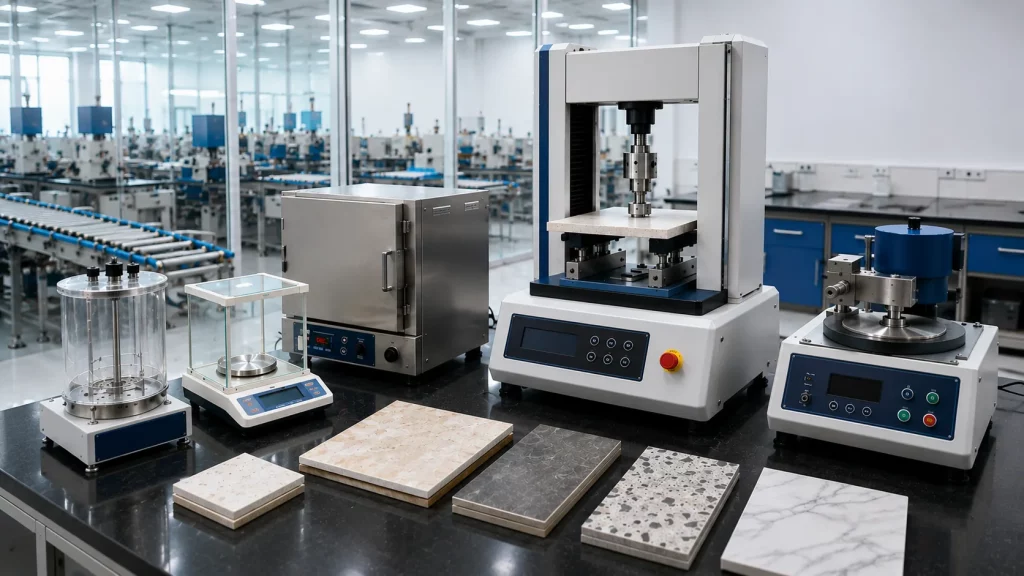
Ceramic and vitrified tile quality is governed by IS 15622:2021 (specifications for tiles) and IS 13630 (methods of test for tiles). From water absorption to breaking strength and abrasion resistance, each physical test requires specific equipment and meets defined acceptance limits. This guide covers everything a tile QC lab needs to set up and operate.
Why Tile Testing Matters
- Ensures consistent product quality and customer satisfaction.
- Water absorption determines tile classification (Group I through Group V) and suitability for wet areas
- Breaking strength ensures tiles resist pedestrian and vehicular loads without cracking
- Abrasion resistance rating determines suitability for foot traffic class (Class 0–5 per ISO 10545-7)
- Chemical resistance verifies tiles withstand household cleaners, acids, and alkalis
- BIS certification under IS 15622 requires all these tests on each tile body type
Key Tests and Equipment
1. Water Absorption Test — IS 13630 Part 4
Classifies tiles by water absorption percentage — critical for indoor vs outdoor, wall vs floor, and frost-resistant applications.
Procedure:
- Dry tiles in oven at 110°C ± 5°C until constant mass. Record dry mass (m₁).
- Boil in water for 2 hours OR vacuum saturate per IS 13630 Pt.4. Cool in water for 4 hours.
- Remove, wipe surface dry, weigh immediately. Record wet mass (m₂).
- Water Absorption (%) = (m₂ − m₁) ÷ m₁ × 100
Equipment: Laboratory oven (110°C ± 5°C), vacuum saturation apparatus (optional), analytical balance (0.01 g resolution), boiling water tank or vacuum chamber.
IS 15622 Classification by Water Absorption
| Group | Water Absorption | Tile Type |
|---|---|---|
| Group Ia | ≤ 0.5% | Vitrified (fully vitreous) |
| Group Ib | 0.5–3% | Semi-vitrified |
| Group IIa | 3–6% | Semi-porous |
| Group IIb | 6–10% | Porous |
| Group III | > 10% | Highly porous (wall tiles) |
2. Breaking Strength and Modulus of Rupture — IS 13630 Part 5
Measures the resistance of a tile to bending failure — directly relates to structural integrity under foot traffic and installation stress.
Equipment: Tile Flexural Strength Tester (3-point bend fixture) with:
- Two parallel lower support rollers (adjustable spacing to suit tile size)
- One upper loading roller centred between supports
- Loading rate: 1 N/mm²/s applied via motorised load frame
- Load cell: 10 kN digital display
Calculation:
Breaking Strength (N) = Maximum load at fracture
Modulus of Rupture (N/mm²) = 3FL ÷ 2bh² (where F = breaking load, L = span, b = width, h = minimum thickness at fracture)
IS 15622 Minimum Values:
- Group Ia (vitrified floor tiles): MOR ≥ 35 N/mm²; Breaking strength ≥ 1300 N
- Group III (wall tiles ≤ 7.5 mm thick): MOR ≥ 15 N/mm²; Breaking strength ≥ 200 N
3. Surface Abrasion Resistance — IS 13630 Part 6 / ISO 10545-7
Evaluates glazed tile resistance to visible surface wear from foot traffic and abrasive particles. Results are rated PEI Class 0–5.
Equipment: Rotary Abrasion Tester (Abrasion Resistance Tester for Tiles) with:
- Steel abrasion cylinder loaded with 70 g steel balls + 3 g corundum powder + 20 mL water
- Rotation at 300 RPM for specified number of cycles (100–1500 cycles for class determination)
- Comparison against standard photographs for class assignment
PEI Abrasion Classes:
- Class 0: Not suitable for flooring
- Class 1–2: Bathroom, low-traffic residential
- Class 3: Light commercial, residential living areas
- Class 4: Heavy commercial, shopping areas
- Class 5: Extra heavy traffic, industrial floors
4. Scratch Hardness (Mohs Scale) — IS 13630 Part 7
Simple comparative scratch test using Mohs hardness pencils (talc=1 to diamond=10). Most vitrified tiles score 6–8 Mohs.
Equipment: Mohs Hardness Kit (set of 10 mineral pencils).
5. Chemical Resistance — IS 13630 Part 13
Tests resistance to household chemicals (acetic acid, ammonia, citric acid, sodium hypochlorite) and pool salts. Required for kitchen and bathroom tiles.
Equipment: Chemical resistance test kit — cylindrical glass tubes sealed to tile surface with wax or silicone, allowing chemical contact for 24 hours at room temperature.
6. Thermal Shock Resistance — IS 13630 Part 9
Tiles cycle between 15°C cold water and 145°C oven for 10 cycles. Any cracking or crazing = failure. Important for outdoor and kitchen tiles.
Equipment: Thermostatically controlled oven + cold water bath + tile holder basket.
Lab Setup for BIS / IS 15622 Compliance
- All instruments calibrated per NABL-traceable standards annually
- Testing room: 23°C ± 2°C, 50% ± 5% RH for dimensional measurements
- Balance: 0.01 g minimum for water absorption; 0.1 g acceptable for breaking strength specimens
- Sample frequency: One test per 5000 m² of production for routine QC
Frequently Asked Questions
What tile tests are mandatory for BIS certification under IS 15622?
Water absorption, breaking strength (MOR), dimensional tolerances (length, width, straightness, flatness), surface quality, and abrasion resistance are mandatory for BIS licence. Chemical resistance and thermal shock are additionally required for specific end-use categories.
Can a single machine test both tile breaking strength and ceramic hardness?
The tile flexural tester is a dedicated 3-point bend setup optimised for tile geometry. Hardness testing uses a separate Mohs kit or Vickers micro-hardness tester for ceramic measurement. They serve different purposes and are not interchangeable.
What is the difference between breaking strength and modulus of rupture?
Breaking strength is the raw maximum load in Newtons — it depends on tile size and thickness. Modulus of rupture normalises this by tile cross-section, giving a material property in N/mm² that can be compared across tile sizes and manufacturers. IS 15622 specifies limits in both units.
Explore our Tile Testing Equipment range — water absorption apparatus, tile flexural testers, and abrasion resistance machines.
