
Paper Testing Equipment: GSM, Bursting Strength & Tensile Tests Explained
Paper and paperboard quality control requires standardised tests — from GSM and bursting strength to tensile, tear, and Cobb sizing. This guide covers every key test parameter, the equipment needed for IS, TAPPI, and ISO compliance, and practical tips for setting up a conditioned paper testing laboratory.
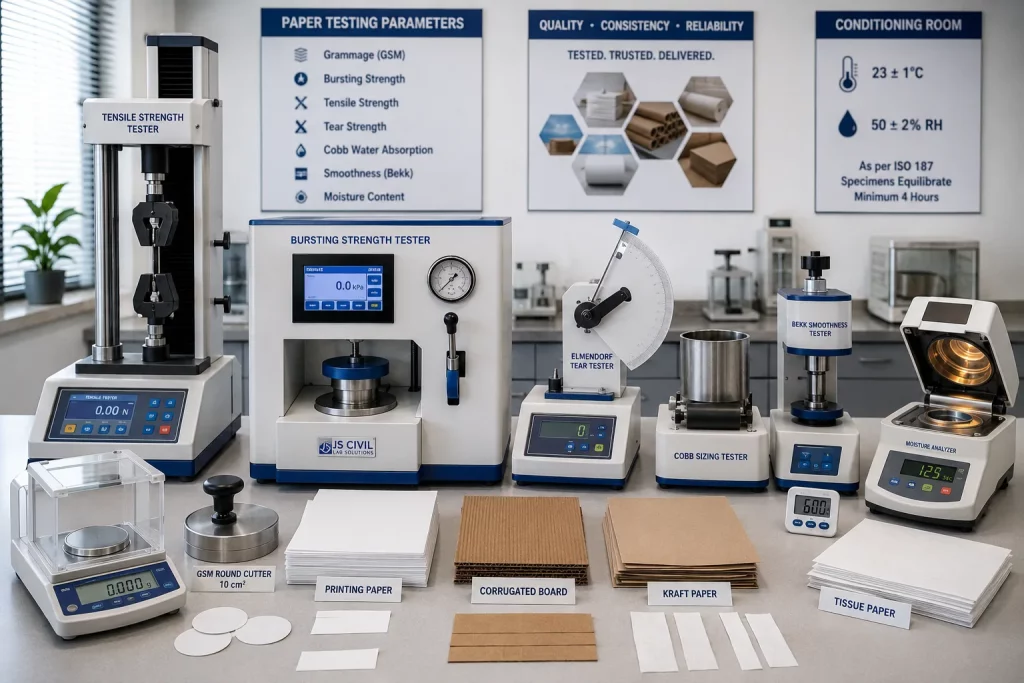
Paper Testing Equipment: GSM, Bursting Strength, Tensile & Quality Tests Explained
Paper and paperboard products must meet strict quality standards before they are used for printing, packaging, publishing, or industrial applications. From measuring Grammage (GSM) and Bursting Strength to evaluating Tensile Strength, Tear Resistance, Cobb Water Absorption, Smoothness, and Moisture Content, every test helps manufacturers ensure consistent quality, durability, and performance.
This guide explains the most important paper testing parameters, the equipment required, and recommended laboratory practices followed in paper mills, packaging manufacturers, research laboratories, and quality control facilities.
Why Paper Testing is Important
Paper quality directly influences printing performance, packaging strength, machine runnability, and customer satisfaction. Routine laboratory testing helps manufacturers:
- Verify compliance with customer specifications and quality standards.
- Maintain consistent production quality across different batches.
- Improve printability, durability, and packaging performance.
- Reduce material wastage and production defects.
- Ensure reliable performance of cartons, corrugated boxes, labels, tissue, and specialty papers.
- Support quality assurance programs and laboratory accreditation.
A well-equipped paper testing laboratory enables manufacturers to identify process variations early, resulting in better product quality and lower production costs.
Essential Paper Testing Parameters
1. Grammage (GSM)
Grammage, commonly known as GSM (Grams per Square Metre), is the most fundamental property of paper. It represents the weight of paper per unit area and serves as the basis for comparing paper grades and evaluating strength properties.
Accurate GSM measurement ensures consistency in printing paper, writing paper, kraft paper, tissue, paperboard, and packaging materials.
Equipment Required
- GSM Round Cutter
- Analytical Balance (0.001 g resolution)
Typical applications include:
- Printing paper
- Copier paper
- Kraft paper
- Corrugated liner
- Duplex board
- Packaging paper
2. Bursting Strength Test
Bursting Strength measures the maximum hydraulic pressure required to rupture paper or paperboard using a flexible rubber diaphragm. It is one of the most important quality parameters for packaging materials because it indicates resistance to rupture under multidirectional stress.
Higher bursting strength generally indicates stronger packaging capable of withstanding handling, stacking, and transportation loads.
Equipment Required
- Digital Bursting Strength Tester (Mullen Type)
- Hydraulic or motorised operation
- Digital pressure display
- Automatic peak hold
Common applications:
- Corrugated board
- Kraft paper
- Sack paper
- Carton board
- Packaging materials
3. Tensile Strength Test
The Tensile Strength Test determines the maximum force required to break a paper strip under controlled loading. Testing is normally carried out in both the Machine Direction (MD) and Cross Direction (CD) because paper exhibits different strength characteristics in each direction.
The test also measures elongation at break, helping manufacturers evaluate flexibility, handling characteristics, and converting performance.
Equipment Required
- Digital Paper Tensile Tester
- Pneumatic or mechanical grips
- Precision load cell
- Adjustable crosshead speed
- Digital test software
Typical applications include:
- Printing paper
- Packaging paper
- Tissue products
- Sack kraft paper
- Flexible packaging
4. Tear Resistance Test
Tear resistance measures the force required to continue an existing tear in paper or paperboard. This property is particularly important for products that experience repeated handling during manufacturing, transportation, and end use.
Higher tear resistance improves durability and reduces product failure.
Equipment Required
- Elmendorf Tear Tester
- Pendulum mechanism
- Multiple capacity options
- Digital result display
Used for testing:
- Kraft paper
- Tissue paper
- Newsprint
- Packaging paper
- Paperboard
5. Cobb Water Absorption Test
The Cobb Test evaluates the amount of water absorbed by paper within a specified time, usually 60 seconds. Water absorption directly affects print quality, ink penetration, adhesive performance, and moisture resistance.
Lower Cobb values generally indicate better sizing and improved resistance to water penetration, making the paper suitable for printing and packaging applications.
Equipment Required
- Cobb Sizing Tester
- Analytical Balance
- Rubber Roller
- Stopwatch
Common applications:
- Corrugated liners
- Folding cartons
- Printing paper
- Food packaging
- Coated paper
6. Smoothness Test
Surface smoothness plays a significant role in print quality, coating performance, and ink transfer. Smooth paper produces sharper images, better colour reproduction, and improved printing efficiency.
Smoothness is commonly measured using air-leak methods under controlled laboratory conditions.
Equipment Required
- Digital Bekk Smoothness Tester
- Vacuum system
- Electronic timer
Ideal for:
- Writing paper
- Printing paper
- Coated paper
- Art paper
- High-quality packaging board
7. Moisture Content Test
Moisture content significantly affects paper strength, dimensional stability, stiffness, and printability. Excess moisture may reduce stiffness, while very low moisture levels can make paper brittle and susceptible to cracking.
For reliable results, paper specimens should be conditioned in a controlled environment before testing.
Equipment Required
- Rapid Moisture Analyzer
- Laboratory Oven
- Analytical Balance
Recommended Laboratory Conditions
Accurate paper testing depends on proper environmental control.
A standard paper testing laboratory should maintain:
- Temperature: 23 ± 1°C
- Relative Humidity: 50 ± 2%
- Specimen conditioning for at least 4 hours before testing
- Dust-free, vibration-free laboratory environment
- Regular calibration of balances, force measuring devices, and testing instruments
Paper should never be tested immediately after production or storage in uncontrolled conditions, as temperature and humidity can significantly influence the results.
Additional Paper Quality Tests
Depending on the application, manufacturers may also perform:
- Ring Crush Test (RCT)
- Edge Crush Test (ECT)
- Box Compression Test (BCT)
- Thickness Measurement
- Folding Endurance
- Brightness
- Opacity
- Ash Content
- Porosity Testing
These tests provide additional information for packaging performance, print quality, and product durability.
Choosing the Right Paper Testing Equipment
Selecting the appropriate equipment depends on the type of paper being manufactured and the quality parameters required.
Modern digital testing instruments offer:
- Automatic test execution
- High measurement accuracy
- Digital displays
- Peak value recording
- USB or computer connectivity
- Easy calibration
- User-friendly operation
Investing in reliable testing equipment improves laboratory efficiency, ensures consistent quality control, and supports compliance with customer and industry requirements.
Frequently Asked Questions
Which is the most important paper quality test?
Grammage (GSM) is the most fundamental test because many strength properties are evaluated relative to the paper’s basis weight.
Why is bursting strength important?
Bursting strength indicates the ability of paper and packaging materials to withstand multidirectional pressure during handling, storage, and transportation.
Why are tensile tests performed in both MD and CD?
Paper fibres align primarily in the machine direction during manufacturing, resulting in different strength characteristics in the machine and cross directions. Testing both provides a complete assessment of paper performance.
Why is conditioning necessary before testing?
Paper absorbs and releases moisture depending on environmental conditions. Conditioning ensures all specimens reach equilibrium, producing accurate and repeatable test results.
Which industries require paper testing equipment?
Paper mills, packaging manufacturers, corrugated box plants, printing companies, research laboratories, educational institutions, quality control laboratories, and inspection agencies all rely on paper testing equipment to maintain product quality.
Complete Paper Testing Solutions
JS Civil Lab Solutions offers a comprehensive range of Paper and Packaging Testing Equipment, including GSM Round Cutters, Analytical Balances, Bursting Strength Testers, Paper Tensile Testers, Elmendorf Tear Testers, Cobb Sizing Testers, Moisture Analysers, and other laboratory instruments designed for accurate, repeatable, and reliable quality control.
Whether you are establishing a new laboratory or upgrading an existing testing facility, our equipment helps manufacturers achieve consistent product quality while supporting efficient production and compliance with recognised testing practices.
