Complete Guide for Civil Material Testing Lab
Setting up a civil material testing laboratory requires more than purchasing testing equipment. To achieve reliable results and prepare for NABL accreditation, laboratories must establish the right infrastructure, install calibrated instruments, implement documented quality procedures, and employ trained technical personnel. Whether you are planning a new laboratory or upgrading an existing facility, selecting the correct […]
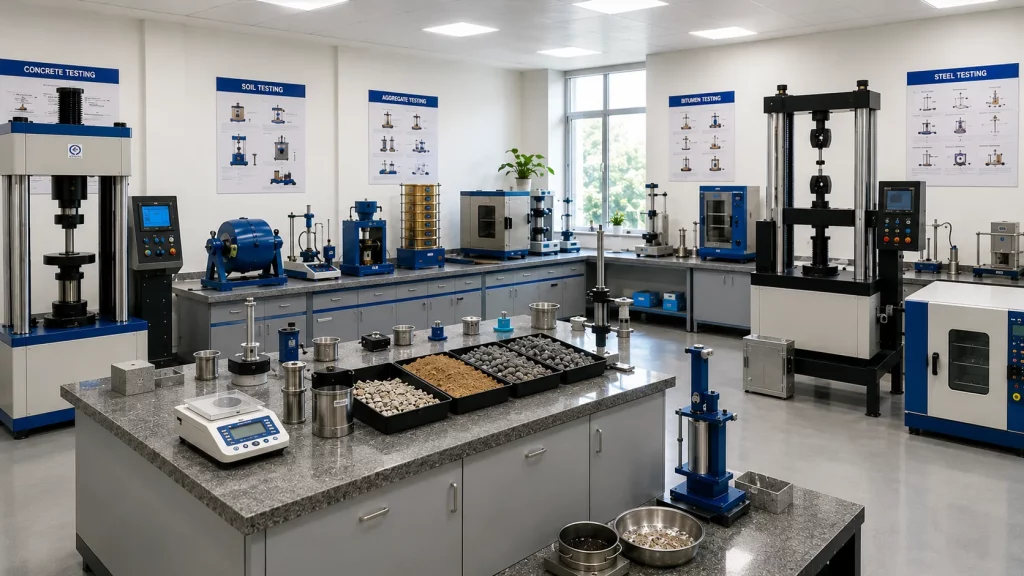
Setting up a civil material testing laboratory requires more than purchasing testing equipment. To achieve reliable results and prepare for NABL accreditation, laboratories must establish the right infrastructure, install calibrated instruments, implement documented quality procedures, and employ trained technical personnel.
Whether you are planning a new laboratory or upgrading an existing facility, selecting the correct equipment from the beginning helps reduce future costs, simplifies accreditation, and ensures accurate testing for construction materials.
This guide provides a complete checklist of laboratory infrastructure, essential testing equipment, calibration requirements, and practical considerations for establishing a modern civil material testing laboratory.
What is NABL Accreditation?
The National Accreditation Board for Testing and Calibration Laboratories (NABL) accredits laboratories that comply with ISO/IEC 17025 requirements for competence, impartiality, and consistent laboratory operations.
For civil engineering laboratories, NABL accreditation demonstrates that testing procedures, equipment, personnel, and quality management systems meet recognised technical standards. Accreditation is widely accepted by government departments, consultants, contractors, infrastructure developers, and third-party inspection agencies.
Why NABL Accreditation Matters
A NABL-accredited laboratory offers greater confidence in the accuracy and reliability of test results.
Benefits include:
- Improved credibility with clients and consultants.
- Eligibility for government and infrastructure projects.
- Better quality assurance and traceability.
- Compliance with recognised laboratory management practices.
- Increased confidence in testing and calibration results.
- Competitive advantage in the construction industry.
Planning Your Laboratory Before Purchasing Equipment
Before investing in laboratory equipment, consider:
- Scope of testing services
- Available laboratory space
- Expected testing volume
- Power and water supply
- Environmental control requirements
- Future expansion plans
- Calibration requirements
- Budget allocation
- Applicable Indian Standards
- Planning these factors early helps prevent unnecessary investment and simplifies future accreditation.
Essential Laboratory Infrastructure
A well-designed laboratory should include dedicated areas for different testing activities.
Recommended infrastructure includes:
- Sample receiving and registration area
- Concrete testing section
- Soil and geotechnical laboratory
- Aggregate testing area
- Cement testing laboratory
- Bitumen testing room
- Steel and mechanical testing section
- Chemical storage area (where applicable)
- Calibration and equipment storage room
- Report preparation and documentation office
The laboratory should also provide adequate lighting, ventilation, drainage, electrical supply, fire safety equipment, and controlled environmental conditions.
Concrete Testing Equipment Checklist
Concrete testing forms one of the largest scopes within a civil engineering laboratory.
Essential Equipment
- Compression Testing Machine (CTM)
- Concrete Cube Moulds
- Slump Cone Apparatus
- Vibrating Table
- Concrete Mixer
- Curing Tank
- Flexural Testing Machine
- Rebound Hammer
- Core Cutting Machine
- Length Comparator
Supporting Instruments
- Electronic Weighing Balance
- Vernier Caliper
- Steel Scale
- Measuring Cylinders
- Temperature Indicators
These instruments are used to evaluate workability, compressive strength, flexural strength, durability, and quality of hardened concrete.
Soil Testing Laboratory Equipment
Geotechnical investigations require specialised equipment for determining engineering properties of soil.
Typical equipment includes:
- CBR Testing Machine
- Standard and Modified Proctor Apparatus
- Sieve Shaker
- IS Test Sieves
- Liquid Limit Device
- Plastic Limit Set
- Shrinkage Limit Apparatus
- Direct Shear Machine
- Triaxial Testing Machine
- Consolidation Apparatus
- Permeability Apparatus
- Core Cutter
- Sand Replacement Apparatus
- Rapid Moisture Meter
- Vane Shear Apparatus
These instruments support soil classification, compaction studies, bearing capacity evaluation, and pavement design.
Aggregate Testing Equipment
Aggregates significantly influence the strength and durability of concrete and pavement layers.
Essential aggregate testing equipment includes:
- Los Angeles Abrasion Machine
- Aggregate Impact Value Apparatus
- Aggregate Crushing Value Apparatus
- Flakiness & Elongation Index Gauge
- Specific Gravity Apparatus
- Sieve Sets
- Sample Splitters
- Drying Oven
These tests determine aggregate strength, shape, grading, abrasion resistance, and overall suitability for construction.
Cement Testing Equipment
Quality control of cement requires accurate laboratory equipment for physical property evaluation.
Typical equipment includes:
- Vicat Apparatus
- Le Chatelier Apparatus
- Blaine Air Permeability Apparatus
- Mortar Mixer
- Compression Testing Machine
- Flow Table
- Autoclave
- Standard Sand Accessories
These instruments evaluate consistency, setting time, soundness, fineness, and compressive strength.
Bitumen Testing Equipment
Road construction laboratories commonly require:
- Penetration Test Apparatus
- Ductility Testing Machine
- Softening Point Apparatus
- Flash & Fire Point Apparatus
- Marshall Stability Testing Machine
- Thin Film Oven
- Bitumen Extractor
These tests ensure that bituminous materials meet project specifications for flexible pavement construction.
Steel and Mechanical Testing Equipment
Laboratories involved in structural materials testing generally require:
- Universal Testing Machine (UTM)
- Tensile Testing Fixtures
- Bend Testing Equipment
- Hardness Tester
- Impact Testing Machine
- Extensometers
These systems evaluate the mechanical properties of reinforcement steel and other metallic materials.
Common Laboratory Support Equipment
Every NABL-ready laboratory should also include:
- Precision Balances
- Hot Air Oven
- Muffle Furnace
- Water Bath
- Desiccators
- Laboratory Glassware
- Temperature and Humidity Monitoring Devices
- Computers and Laboratory Reporting Software
- UPS Power Backup
Supporting equipment is equally important for maintaining testing accuracy and traceability.
Calibration Requirements
Calibration is a key requirement for laboratory competence.
Critical equipment should have:
- Valid calibration certificates
- Traceability to recognised standards
- Scheduled calibration intervals
- Equipment identification labels
- Preventive maintenance records
- Intermediate verification checks
Maintaining proper calibration records is essential during NABL assessments.
—
Documentation Required for NABL
Besides equipment, laboratories should maintain:
- Standard Operating Procedures (SOPs)
- Equipment Register
- Calibration Register
- Sample Register
- Maintenance Records
- Internal Audit Reports
- Quality Manual
- Staff Training Records
- Test Report Formats
Well-maintained documentation demonstrates effective laboratory management and compliance with quality requirements.
Common Mistakes Before NABL Assessment
Many laboratories experience delays due to avoidable issues such as:
- Missing calibration certificates
- Incomplete equipment records
- Improper environmental monitoring
- Incorrect test method selection
- Poor equipment maintenance
- Inadequate staff training
- Incomplete documentation
Addressing these issues before assessment improves readiness and reduces non-conformities.
Why Choosing the Right Equipment Supplier Matters
Selecting an experienced laboratory equipment supplier offers benefits beyond product delivery.
Professional suppliers can assist with:
- Equipment selection
- Laboratory planning
- Installation and commissioning
- Calibration support
- Operator training
- Preventive maintenance
- Annual Maintenance Contracts (AMC)
- Technical documentation
Reliable after-sales support helps laboratories maintain long-term testing accuracy and operational efficiency.
Complete Civil Laboratory Solutions
JS Civil Lab Solutions supplies a comprehensive range of laboratory equipment for concrete, soil, aggregate, cement, bitumen, steel, and material testing applications. Our team assists laboratories with equipment selection, laboratory planning, installation, calibration guidance, and technical support to help establish efficient testing facilities aligned with recognised laboratory quality requirements.
Whether you are setting up a new civil material testing laboratory or expanding an existing facility, choosing the right equipment and implementing proper quality systems from the beginning creates a strong foundation for reliable testing and future accreditation.