
Marshall Stability Test for Bituminous Mixes IS 17127 Procedure & Equipment
The Marshall Stability Test is the standard method for designing and quality-checking hot mix asphalt (HMA) in India. Standardised under IS 1201 and referenced in MORTH specifications, it determines the Optimum Bitumen Content (OBC) and verifies stability and flow values for road construction. This guide covers equipment, procedure, and acceptance criteria.
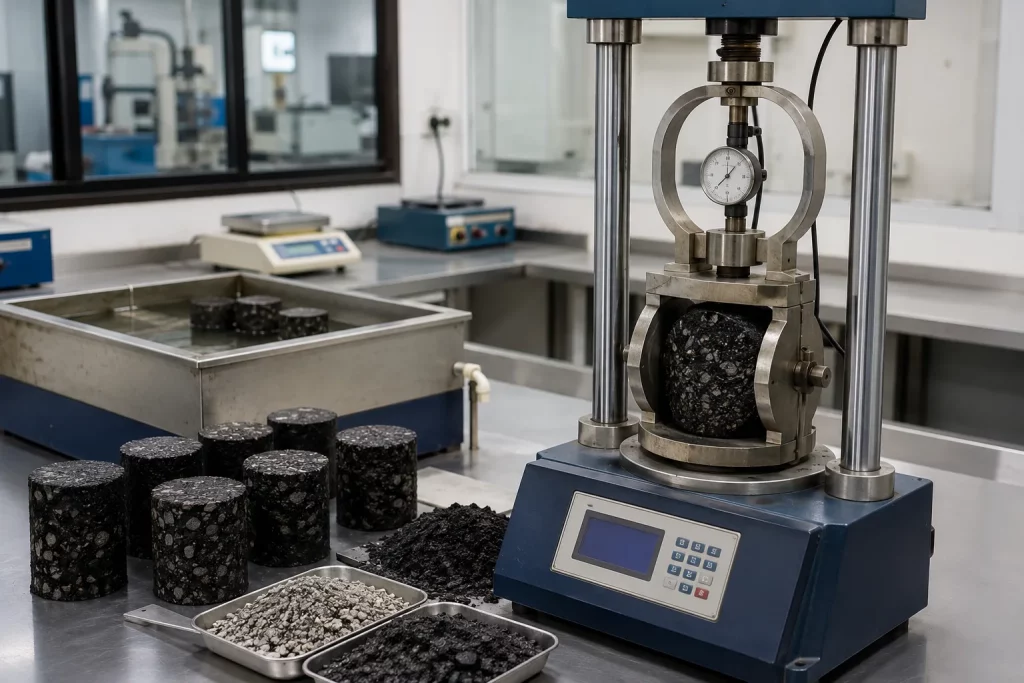
The Marshall Stability and Flow Test is the most widely used method for bituminous mix design and quality control in India. Standardised under IS 17127 and mandated by MORTH Specifications for Road and Bridge Works, it determines the Optimum Bitumen Content (OBC) and evaluates resistance to deformation under traffic loading.
What Does the Marshall Test Measure?
- Marshall Stability: Maximum load (in kN) a 63.5 mm × 101.6 mm cylindrical specimen can sustain at 60°C
- Marshall Flow: Deformation (in mm) at maximum load — indicates flexibility vs rigidity
- Air Voids (Va): Percentage voids in the compacted mix — affects durability and rutting
- Voids in Mineral Aggregate (VMA): Space for bitumen film and voids
- Voids Filled with Bitumen (VFB): Percentage of VMA filled with bitumen
Equipment Required
Marshall Compactor
Motorised or manual compaction hammer — 4.536 kg (10 lbs), 457 mm (18 inch) drop height. Each specimen face compacted with 75 blows (heavy traffic) or 50 blows (medium traffic).
Marshall Mould Set
- 101.6 mm (4 inch) internal diameter cylindrical steel mould
- Extension collar and base plate
- Specimen ejector (push-out device)
Marshall Testing Machine
The core instrument — applies load to specimen through curved breaking heads at 50.8 mm/min (2 inches/min) constant rate.
- Load cell: 25 kN or 50 kN digital load cell with peak-hold function
- Flow meter: Dial gauge or LVDT measuring deformation to 0.1 mm resolution
- Water bath: 60°C ± 1°C thermostatically controlled bath for 30–40 minute specimen conditioning
Water Bath
Stainless steel bath with digital thermostat control maintaining 60°C ± 1°C — the temperature simulating peak summer pavement surface temperature in India. Test must be completed within 30 seconds of specimen removal from bath.
Mixing and Heating Equipment
- Mechanical mixer for aggregate-bitumen blending
- Oven for aggregate pre-heating to 160–170°C and bitumen to 140–150°C
- Bitumen viscometer for temperature-viscosity determination
Step-by-Step Procedure
- Aggregate gradation: Blend aggregate fractions to meet MORTH Grading I, II, or III as specified. Aggregate must pass specified sieves and meet individual IS tests (AIV, LAA, Flakiness Index).
- Trial bitumen contents: Prepare specimens at 5 bitumen contents — typically OMC ± 1.0% and ± 0.5% around the estimated optimum (usually 4–6% for DBM, 5–7% for BC).
- Specimen preparation: Heat aggregate and bitumen. Mix thoroughly. Fill mould. Compact with 75 blows per face (heavy traffic). Cool to room temperature. Eject and mark.
- Bulk density: Measure specimen dimensions. Weigh in air and water for bulk specific gravity (Gmb).
- Conditioning: Submerge specimens in 60°C water bath for 30–40 minutes.
- Test: Place specimen between breaking heads. Apply load at 50.8 mm/min. Record maximum load (Stability) and deformation at maximum load (Flow).
- Stability correction: Multiply raw stability by volume correction factor from IS 1201 Table — compensates for specimens not exactly 63.5 mm height.
- OBC determination: Plot Stability, Flow, Va, VMA, and VFB vs bitumen content. OBC = average bitumen content satisfying all MORTH criteria simultaneously.
MORTH Acceptance Criteria (5th Revision)
| Parameter | Dense Bituminous Macadam (DBM) | Bituminous Concrete (BC) |
|---|---|---|
| Stability (min) | 9.0 kN | 9.0 kN |
| Flow (mm) | 2–4 | 2–4 |
| Air Voids Va (%) | 3–6 | 3–5 |
| VMA (%, min) | 11–13 (grade-dependent) | 12–14 |
| VFB (%) | 65–75 | 65–75 |
Frequently Asked Questions
What is the significance of 60°C test temperature?
60°C approximates peak pavement surface temperature in Indian summer conditions. Testing at this temperature evaluates rutting resistance under the most critical service condition — heavy vehicle loads on hot summer days.
What is the difference between Marshall and Superpave mix design?
Marshall uses empirical stability and flow criteria. Superpave (AASHTO) uses performance-graded binders and gyratory compaction to simulate field compaction more accurately. MORTH 5th Revision permits Superpave for NH projects but Marshall remains the standard for state roads.
Why does stability need to be corrected for specimen height?
Taller specimens mobilise more aggregate interlock and give higher raw stability. The IS 1201 correction factor normalises all specimens to the standard 63.5 mm height for valid comparison across specimens.
View our Bitumen and Pavement Testing Equipment range including Marshall testing machines, compactors, and water baths.
